The Site
A citadel above the Mediterranean
Surmounting a naturally fortified limestone plateau along Malta’s dramatic western coastline, il-Qlejgħa tal-Baħrija is an extraordinary prehistoric blueprint and the definitive guide-site for the final phase of the Maltese Bronze Age (900 BC - 700 BC). Embraced by wild garigue, sheer cliffs, and a fertile valley, the site offers an untouched landscape where ancient history remains intimately bound to nature.
The site is assigned a Class A scheduled archaeological site and an IUCN Category III Natural Monument.
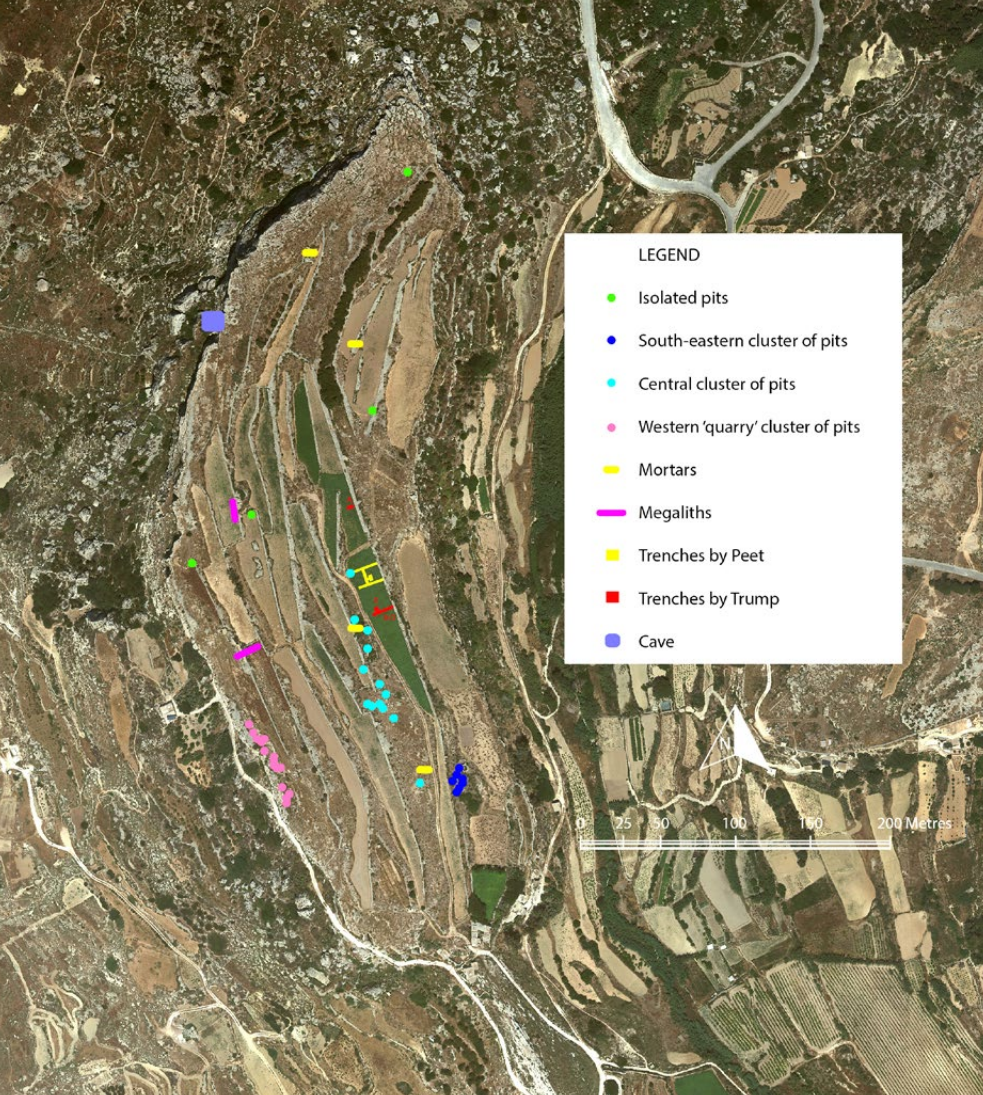
Satellite image showing the various features and excavations documented on Qlejgħa tal-Bahrija, including pit clusters, mortars, megaliths, and trench locations from Peet (1909) and Trump (1959). From "Il-Qlejgħa tal-Baħrija: The Story," by D. Cardona, 2020, in D. Tanasi & D. Cardona (Eds.), The Maltese Archipelago at the Dawn of History: Reassessment of the 1909 and 1959 Excavations at Qlejgħa tal-Bahrija and Other Essays, p. 5, Figure 2. Copyright 2020 by Archaeopress Publishing Ltd.
Inhabited through the ages
While famed as a thriving late Bronze Age village and industrial centre, the story of il-Qlejgħa tal-Baħrija extends far beyond prehistory. Material evidence reveals a continuous human presence spanning millennia:
The Bronze Age Village - A sophisticated community featuring wattle-and-daub domestic structures, built hearths, and extensive rock-cut silo clusters engineered for resource storage.
Antiquity & Beyond - Surface assemblages and ceramic evidence confirm activity and settlement across the Phoenician, Punic, Roman, Byzantine, Islamic, and Medieval periods.
Troglodytic Settlements - Natural cliffside caves served as inhabited shelters well into the early modern era, leaving behind a rich, multi-layered cultural narrative.
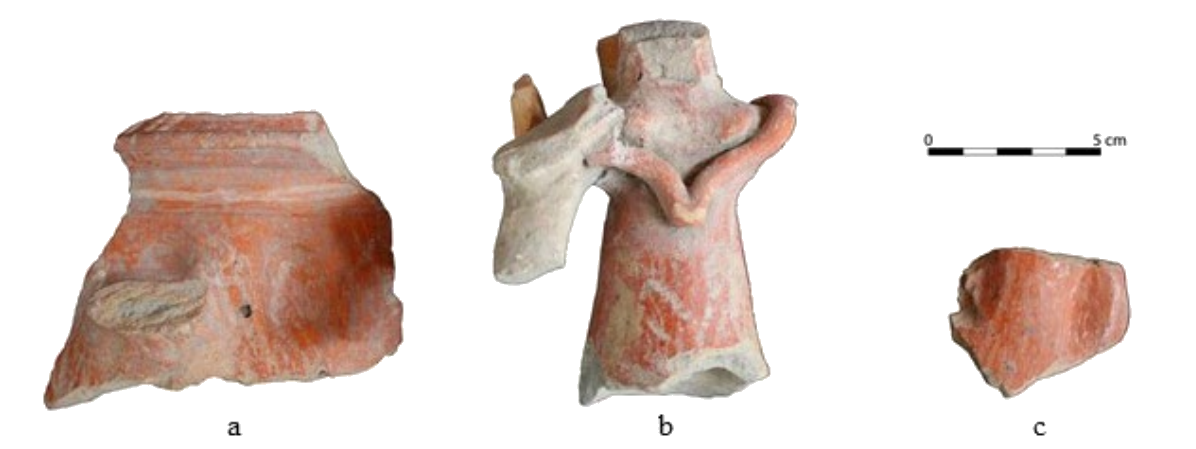
Image - Lamp Holder Fragments. From "Post-Prehistoric Pottery from the 1909 and 1959 Excavations at Qlejgħa tal-Bahrija," by S. Hassam, 2020, in D. Tanasi & D. Cardona (Eds.), The Maltese Archipelago at the Dawn of History: Reassessment of the 1909 and 1959 Excavations at Qlejgħa tal-Bahrija and Other Essays, p. 102, Figure 4. Copyright 2020 by Archaeopress Publishing Ltd.
Evidence of Exceptional Significance
Very little of the site has been systematically excavated. Yet, even from these limited early investigations, the site has yielded extraordinary evidence:
Biomolecular Discoveries - Recent cutting-edge paleoproteomic and archaeometric analyses of pottery residues have provided rare organic proof of ancient Mediterranean diets, including cattle farming and early cheese production.
Prehistoric Industry - Discoveries of over 60 loom weights and spindle whorls point to a flourishing local textile economy, while unique ceramic “cheese-strainers” and terracotta figurines reveal a community of remarkable artistic and industrial craft.
Early Craftsmanship - The plateau contains the earliest documented stone quarry in the Maltese Islands, underscoring the deep-rooted relationship between the island's inhabitants and stone.